“Prizefighter” combines a smoother collaborative approach with the familiarity of Mumford & Sons’ acoustic style. The collaborations include Chris Stapleton, Hozier, Grace Abrams, and Gigi Perez, with The National’s Aaron Dessner producing. Rather than focusing on anthems ready for arenas/stadiums, the band’s attention is on emotional openness.
The record opens with Chris Stapleton featuring on ‘Here’, where Chris and Mumford & Sons frontman Marcus Mumford exchange verses over a country-inspired duet. The following track, called ‘Rubber Band Man’ with Hozier, has the same premise over strong harmonies and delicate acoustic. The song was given to Marcus after Brandi Carlile had a dream about him singing it. It expresses longing and hope.
‘Run Together’ and ’The Banjo Song’ adopt the modern folk of stomp-and-clap that the band were initially known for, but more mature and restrained.
‘Conversation with My Son (Gangsters & Angels)’ sees the band broaden their horizon with honest storytelling, combining broader emotion with personal narrative.
The title track and ‘Begin Again’ explore love, resilience and doubt, which is what the album is all about. These more delicate shifts make Marcus’ earnest lyricism, careful arrangements, and the band’s harmonies rise above.
New layers surface when Gig Perez and Gracie Abrams featured on ‘Icarus’ and ‘Badlands’, respectively. They do appear to overpower Marcus’ vocals during certain sections, which probably was not meant to happen.
Some songs are weakened by the record’s mid-tempo, polished production, like ‘Alleycat’ and ‘I’ll Tell You Everything’, which do not fit the band’s raw emotion. The closer ‘Clover’ is a gentle finish, but still shows the thoughtful mood of the album.
“Prizefighter” may be a safe option by bringing familiarity, but there are seldom anthemic songs, which we associate with their beginnings. It’s a solid record that showcases their prowess with warm acoustic sounds, vulnerability, and thought-provoking lyrics.
The only thing that has changed is that anthemic songs have given way to more mature, subtle ones.
Song recommendations: ‘Rubber Band Man’, ‘Here’, ‘Conversation with My Son (Gangsters & Angels)’
Mumford & Sons. The name alone has me picturing folk and Americana and the familiarity of the banjo. It took me a while to come around to their music. I didn’t dislike them; I found “Sigh No More” ideal as background music. But they never quite captured my full attention, remaining a band I politely tolerated rather than passionately embraced.
However, over time, their music began to seep into my consciousness, altering my perception and kindling a newfound appreciation.
It was 2015, and I was settling in to watch “Later…with Jools Holland,” expecting the usual mix of established acts and rising indie darlings. When Mumford & Sons performed, I expected to hear the usual. I was utterly taken aback by what I heard.
What followed was a sonic jolt. The band launched into “The Wolf,” a track that shed the banjos and acoustic guitars in favour of distorted electric guitars, driving drums, and a raw, almost primal energy. That folk element everyone had been accustomed to was replaced by a full-blown rock attitude. I was completely taken aback. This was the side of the band I had yet to have heard.
It was a revelation. The track was powerful. Signalling a significant shift in the band’s sound. It was a risk that paid off. After that appearance on Later, I decided to give the band a proper chance, diving deeper into “Wilder Mind” and re-evaluating their entire discography. I particularly enjoy watching/listening to their live shows.
Now, let’s delve into some background on this West London ensemble. Mumford & Sons, formed in 2007, comprising of members Marcus Mumford (vocals, guitar, drums, mandolin), Ben Lovett (vocals, keyboards, accordion, drums), Winston Marshall (vocals, banjo, guitar, dobro. Winston left the band in 2021), and Ted Dwane (vocals, bass guitar, double bass, drums, guitar). They quickly and impressively rose to prominence with their distinctive blend of folk, Americana, rock, and bluegrass, characterised by their soaring vocals, intricate instrumentation, and introspective lyrics. Their early albums, including “Sigh No More” and “Babel,” were massive commercial successes, cementing their place as one of the most popular bands of the decade.
However, with “Wilder Mind,” they consciously moved away from their signature sound, embracing a more electric and expansive sonic palette. While the change would inevitably divide fans, it opened them up to a broader audience and allowed them to explore new creative avenues.
What followed was the 2018 album, “Delta”. Another record showing their ambition and their willingness to experiment with various sounds, and connect with a global audience. Their collaboration with African musicians such as Baaba Maal seemed to have inspired this direction, making their music resonate with a wider, global audience. It may not have sounded like their first two albums, but it proved that they could push the creative boundaries. Now we are up-to-date on what the band released and Winston Marshall’s departure amid controversy in 2021; we will crack on with the review “Rushmere”—their first record in a staggering seven years.
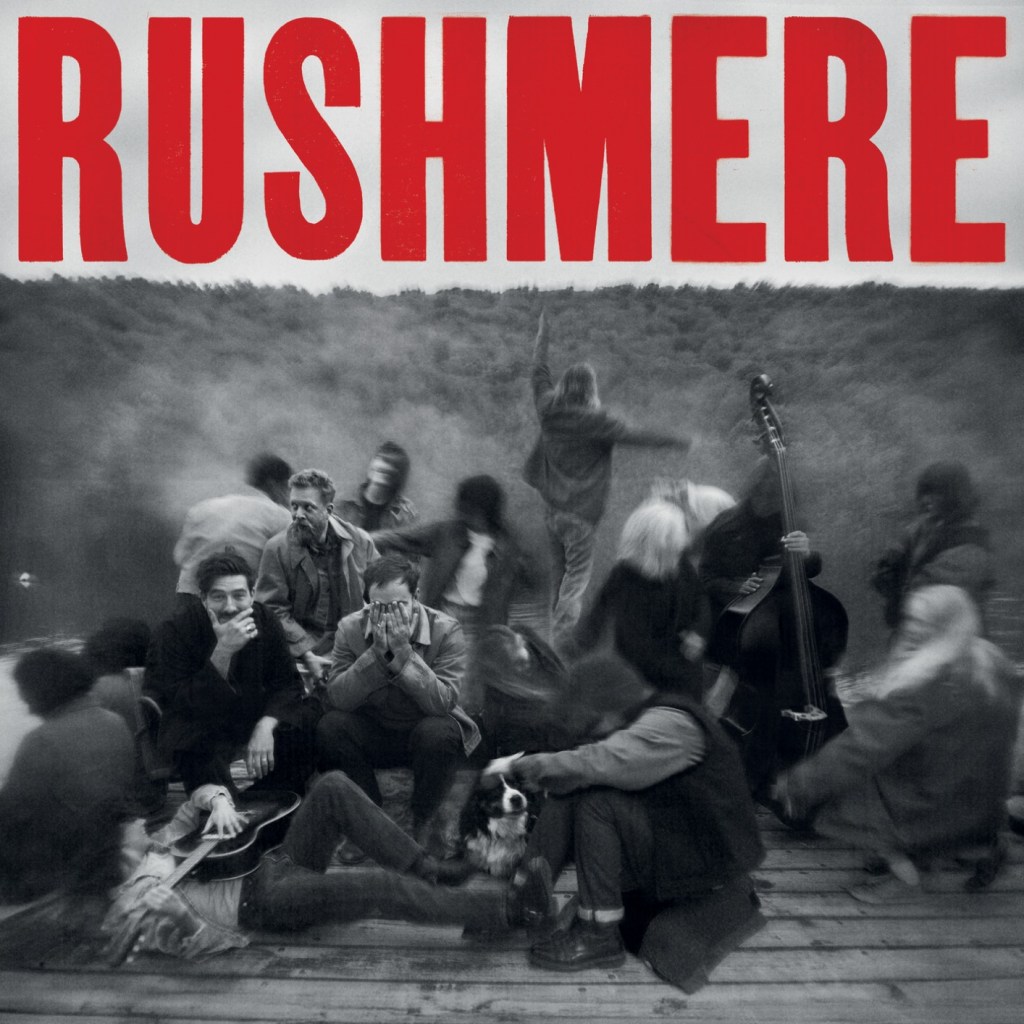
Why “Rushmere”? The title carries a double meaning. Rushmere, a lake in Wimbledon, South-West London, is where the band formed, and this record is a return to their roots. The album, therefore, is reflective. Recorded in RCA Studio A, Nashville, and their home studio in Devon, this period from 2022 to 2024 was their most productive. Interestingly, frontman Marcus Mumford released a solo album the same year the band returned to the studio. This decision might have been influenced by a conversation with Noel Gallagher in a London pub, where he challenged Marcus to fully utilise his songwriting talent, both as a solo artist and with the band.
As usual, the songs ease your soul and are just the tonic when you feel the world’s weight on your shoulders. The album itself has a confessional lyricism and offers hope as the record goes on. So stick with it, even though the beginning is downcast.
Despite the melancholic verses, the opener ‘Malibu’, also their latest single, starts with that unmistakable rousing chorus.
It’s intriguing that others, rather than just the band, wrote a few songs. Adele and Liam Gallagher songwriter Greg Kurstin is one of them. He writes the title track and sends it in a Fleetwood Mac direction. The band’s adaptation of Fleetwood Mac on ‘Caroline’ is a fascinating development, suggesting a new direction for their music. More than likely drawing inspiration from Greg’s song. Returning to the title track, it was the teaser and leading single. It is a song that is the quintessential folk side of the band enveloped with Fleetwood Mac. ‘Monochrome’ is a romantic ballad that somewhat lightens the mood.
’Truth’ is when the mood shifts, with Marcus radiating confidence over the track. However, this confidence is short-lived, as we soon arrive at the fittingly titled ’ Surrender’. While I believe this is the piano ballad, it’s been a few days since I last heard it, so my memory might not be entirely accurate. In the early section of the song, you can hear his vocals breaking, a clear sign of the emotional depth he’s delving into. Marcus’s performance is a masterclass in emotional expression as he transitions from powerful vocals to tender ones, reflecting a profound ache and a heart struggling to heal.
As I mentioned earlier, the album is reflective, and the lyricism mirrors that. You believe every heart-shredding vocal that Marcus delivers. It’s the same as when he delivers vocals displaying optimism. While the band has always been known for their jovial and forthright songs, this album marks a significant evolution, showcasing a level of maturity we haven’t seen before. The record harks back to the heady days, a nostalgic treat for those who appreciate it. As for me, I’m still processing my feelings about it. However, I can’t help but admire the depth of the lyricism. The album’s conclusion with ‘Carry on’, a song brimming with hope, is a fitting end.
Song recommedations: ’Carry on’, ’Truth’, ‘Malibu’

 Honest Opinions